


Amazon's 'Free Meek' Docuseries Traces the Rapper's Baffling Decade-Long Legal Battles
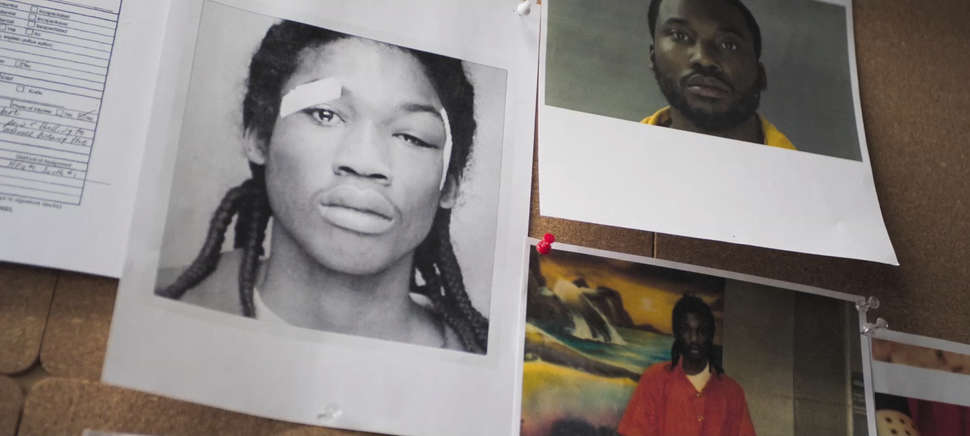
Amazon's new docuseries covers a decade-spanning story of injustice
that could've been about any black, brown, or impoverished person
caught in the trappings of the United States' criminal justice system.
It just so happens to be about Meek Mill. Free Meek is rooted
in the efforts to free the North Philadelphia rapper from prison after
he was sentenced to two to four years for popping wheelies on a dirt
bike without wearing a helmet in late 2017. It was a shocking sentence
that the prosecution wasn’t seeking, but it was the choice of Judge
Genece Brinkley, Meek's longtime judge and the documentary's chief
antagonist.
After
word of the egregious ruling spread, the #FreeMeek movement dominated
Twitter feeds and news circuits. It wasn't a situation like Tekashi
6ix9ine's that entailed violence and drug trafficking and left the
hip-hop community divided -- Meek's was bogus. From his label honcho
Rick Ross to his once arch-nemesis Drake, artists across the board stood
in solidarity, and people from all walks of life voiced their support
for Meek Mill. This five-part series documents Meek's career and legal
woes, shedding light on how the "Dreams and Nightmares" emcee became a
co-chair and founding partner of REFORM Alliance,
an organization dedicated to criminal justice reform that was founded
by the likes of billionaires such as Jay-Z and businessman Michael
Rubin.
Free Meek isn't
a congratulatory epic detailing how he came to be released from jail in
April 2018 and drop the biggest album of his career. It's an
infuriating and at times bleak account because, as the series is quick
to establish, Meek Mill is not free. Like countless others out on
probation or parole, he is subject to court supervision and can be sent
back to prison at any moment for violating the terms of his probation.
The incredible highs of Meek's meteoric rise from a battle rapper to a
household name are swallowed and shat out every episode as viewers
witness the snares of America's post-conviction system, from unrealistic
travel restrictions to harsh sentencing for nonviolent acts. Only
through callbacks of familiar tunes and the landmark events of his
career does it avoid becoming altogether too dismal.
From behind-the-scenes looks at the making of 2014's Wins & Losses
to his past relationship with Nicki Minaj, these inclusions serve as a
backdrop for his legal struggles. This is the story of Robert Rihmeek
Williams' fight for freedom, but it enjoys the spoils of the fact that
he's a multi-platinum recording artist who makes for a compelling
screening. This approach makes the three-hour endeavor much easier to
stomach but all the more visceral. His journey benefits from luxuries
not afforded to the average person, yet the system fails him
nevertheless. Free Meek nails that concept to brandish one of its central arguments: No one is free until Meek is free.
Over
five installments, the docuseries achieves its effectiveness through
talking-head interviews, real-life footage such as Meek recording "1942
Flows," and reenactments of events not caught on camera. The interviews
guide the discussion and feature commentary from Meek's family, industry
professionals, and other celebrities. His family's cross-generational
perspective -- from his mother, grandmother, son, or sister --
especially is the soul of the series, their compassion oozing through
every anecdote. Eye-opening analyses from legal experts such as REFORM
Alliance CEO (and CNN commentator) Van Jones and tenured investigative
journalist Paul Solotaroff bring clarity to Meeks's case and reveal its
inextricable ties to the corruption of law enforcement and the loopholes
of court supervision.

However,
it's the reenactments that bring Meek's struggles to life. The crisp
scenes allow viewers to visualize moments that couldn't be captured on
film for a variety of reasons, such as the pre-body cam era when Meek
was initially arrested or Philadelphia's strict stance against cameras
in courtrooms and judge’s chambers, which has spawned myths such as
Meek’s allegation that Judge Brinkley requested that he remix Boyz II
Men’s "On Bended Knee" and shout out the important women in his life,
Brinkley included. The legendary mugshot that went on to become the
cover of his 2016 Dreamchasers 4 mixtape hits different after seeing the events that led up to it during Free Meek's
first episode, and the incessant depictions of courtroom proceedings
are fatiguing, even as a spectator. These Minka Farthing-Kohl-directed
productions are best executed in the fourth installment, a How to Get Away With Murder-esque
chapter illustrating the exploits of Tyler Maroney and Luke
Brindle-Khym, a team of private investigators hired to find
discrepancies within Meek's case. Contrary to earlier episodes that
aimed to breathe reality into the unimaginable, this standout episode
features on-location segments that recreate law enforcement claims in
order to discredit them, exposing that corruption was always a factor in
his legal nightmare.
The overall framing is downright impressive. From the interviews to the reenactments, Free Meek
has complete control over its narrative. It unapologetically leans into
its bias without omitting Meek's shortcomings, setting up a space where
a person of color can be in the wrong without being subject to police
brutality or heinous sentencing. By showcasing low points such as his
probation violation in the midst of Hurricane Sandy and his Percocet
addiction on full display, the series is able to critique discriminatory
search and seizure practices and the negative effects that
incarceration has on one's mental health. At one point, it even resorts
to using an ethically questionable microphone gaffe while interviewing
Judge Brinkley's lawyer. Existing outside the realm of journalism, Free Meek plays its game accordingly, and gutsy decisions like that make the results electrifying.

"It
was only a matter of time before you had a rapper like Meek Mill take
on the system," Van Jones says in the final episode. "That guy has a
destiny way bigger than he knows."
In the months following his release from prison in 2018, Meek Mill released Championships
to commercial success and critical acclaim. On "Oodles O' Noodles
Babies," the thirteenth track from the record, he begins with a chilling
statement over a rich soul sample: "His ma' smoked the crack while she
was pregnant, so he can't even help that he crazy. He goin' to jail,
it's inevitable."
The sobering Free Meek
echoes that sentiment of inevitability. From his fateful arrest in
2007, there was a path paved out for Meek Mill, and that same path has
dismantled the lives of millions of people of color and those less
fortunate. Meek still isn't free at the conclusion of the five-part
series, yet in its final moments he calls himself lucky. Even after
three hours of watching the celebrity float through the criminal justice
system like the plastic bag from American Beauty, one can't
help but agree. Without his extensive resources, the everyday person
doesn't stand a chance, so Meek's decision to use his platform to affect
change is the triumphant coda that this tumultuous tale deserves. The
amplification of the discussion about mass incarceration, mass
supervision, and justice reform makes it pressing, but the chronicling
of Meek Mill embracing his destiny is what makes Free Meek glorious.
Sign up here for our daily Thrillist email, get Streamail for more entertainment, and subscribe here for our YouTube channel to get your fix of the best in food/drink/fun.


Comments
Post a Comment